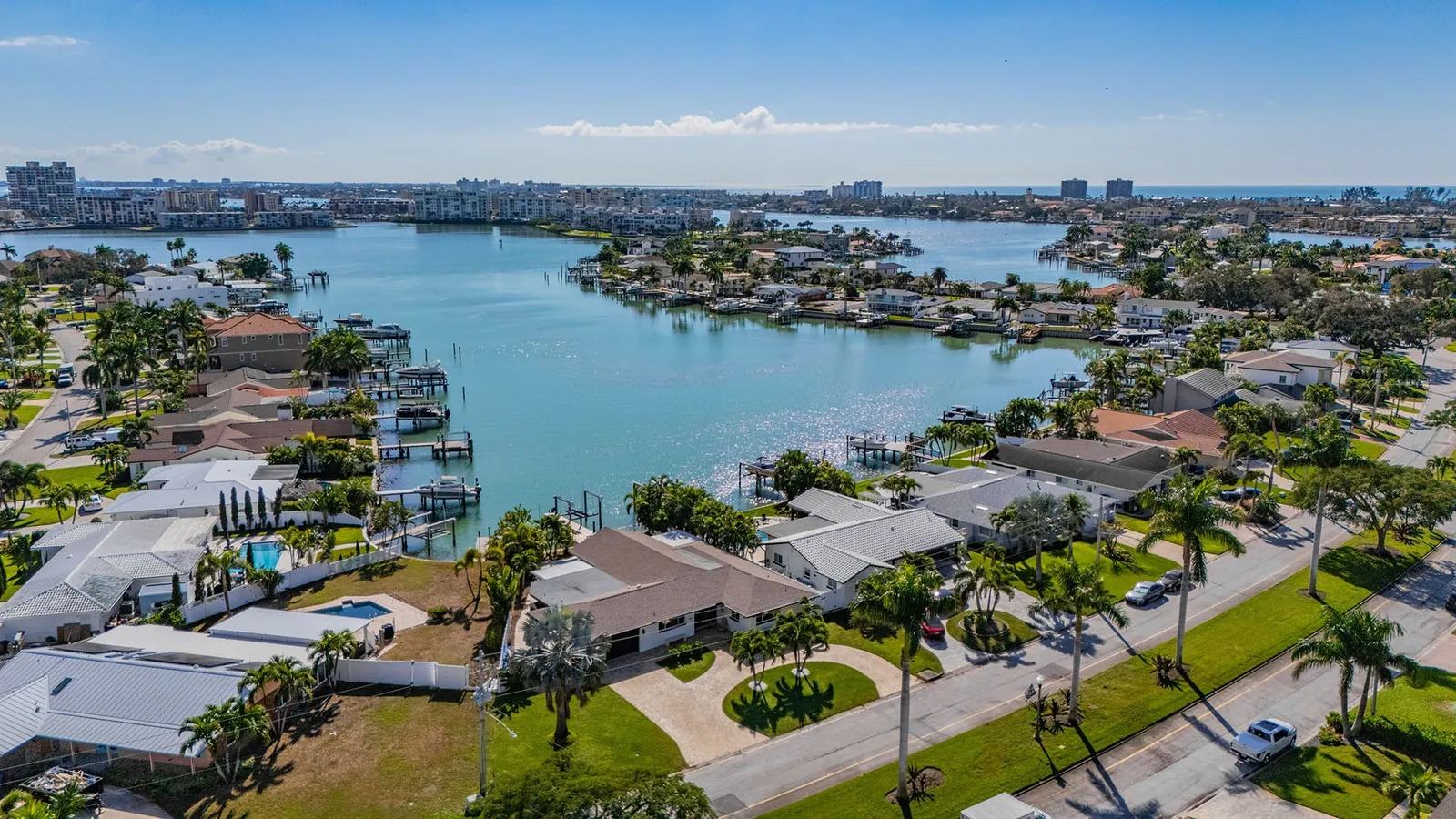
Stand in a backyard in Yacht Club Estates, look at the seawall and the dock and the boat tied up behind the house, and you are looking at something that was the bottom of Boca Ciega Bay inside the memory of people still living. Not next to the bay. The bay. The ground under the lawn was open salt water a mullet could swim over, until a dredge pumped it up into the shape of a street.
And here’s the part that doesn’t sort itself out at first. This is a neighborhood built entirely on the water — nearly every one of its homes with a canal out back and the bay a short idle away. Yet the thing that actually keeps those houses cool has nothing to do with the water at all. It comes out of a machine bolted to the side of each one.
For every Florida town built before this one, the water was the whole point. Here, the water is the view, and the cooling comes from somewhere else.
Cool used to be a place you went
To see why that’s strange, you have to put the air conditioner back in the box it came in and imagine Florida without it.
For most of the state’s history there was no machine to cool a house, so the house itself had to do the job. Builders raised the floors off the ground to let air move underneath. They ran the ceilings high so the heat had somewhere to go, wrapped the walls in deep porches for shade, and put a metal roof overhead to throw the sun back at the sky. Windows were tall and faced each other, so whatever breeze there was could walk in one side of the house and out the other.

So cool was never something you owned. It was somewhere you went. The shady side of the street. The porch after supper. And above all, the edge of the water, where the breeze came in off the Gulf and did the one thing no indoor room could manage on a July afternoon — it moved.
St. Petersburg built a whole personality out of that. It called itself the Sunshine City and sold the open air as the main attraction. Downtown, the town set out thousands of green benches along the sidewalks, and the retirees who had come south for their health sat out on them in the shade, because the sidewalk in the breeze beat any room indoors. The town’s living room was the street.

That was the deal Florida ran on for a hundred years: come for the climate, and live your life out in it, because indoors was the last place you wanted to be when the heat came down.
Then two machines showed up at once
In the 1950s, along the bay west of downtown, two machines arrived close enough together that it’s worth noticing. One made the land. The other made the land worth living on.
The first was the dredge. It worked like a vacuum run in reverse: it sucked sand and shell and muck up off the bay bottom and sprayed it out through a floating pipe, piling the bottom of Boca Ciega Bay into new ground. Developers did this up and down the lower bay through the decade — shaping the fill into long fingers of land, a canal and a seawall down each side, so that every lot they drew came with water behind it and a place to tie a boat.

Yacht Club Estates is one of those hands of fingers, out by the Treasure Island Causeway. The first houses went up in 1959, and the neighborhood kept filling in through the sixties and into the seventies, lot by lot, as the ground dried enough to build on.

The second machine was smaller, and it changed everything about what got built on that new ground.
The house that quit the breeze
By the end of the 1950s, the air conditioner had finally shrunk and cheapened enough to sit in an ordinary window and cool an ordinary room. And once it did, the Florida house stopped having to work for its own comfort.

What went up on the dredged lots wasn’t the old high-ceilinged, deep-porched house built to breathe. It was the ranch: long and low, laid flat on a concrete slab, walls of concrete block, a wide picture window that mostly looked nice and didn’t much open. A box, really — close it up tight and run a machine, and you keep the cool in the way a cooler keeps ice.
You could only get away with that in Florida because of the air conditioner. Before it, a sealed low box with the windows shut in August would have been the hottest place for a mile, and no one would have signed for it. After it, that same box was simply a floor plan — and a cheap, fast one to pour by the hundred. The machine is the whole reason a builder could stop designing for the wind.

The bay they filled in to look at
So the breeze is still out there. It comes up Boca Ciega Bay every afternoon off the Gulf, the same wind that cooled every porch on this coast for a hundred years. In Yacht Club Estates it blows past a few hundred houses that mostly don’t need it. The windows that could stand open to it are shut, and behind them the machines hum.

And the filling-in didn’t come without a bill. Scooping the bottom up into subdivisions smothered the shallow grass flats that the bay’s fish and shellfish lived on, and the open water kept shrinking a finger of land at a time. People noticed. A fight over dredging and filling one more corner of this same Boca Ciega Bay went all the way to the federal courts, and helped settle a thing nobody had nailed down before — that owning the bottom of a bay didn’t mean you could simply pump it into dry land whenever it paid.
In 1968 the state drew the line here on purpose, naming Boca Ciega Bay an aquatic preserve to stop the dredging for good. Yacht Club Estates had made it in just under the wire. It is, in a real sense, one of the last of its kind — a neighborhood that exists because, for a few years, you still could make land out of a bay, and a machine had just arrived that made anyone want to.
What’s left standing on the fill
The fingers of land are all still there, grown in with palms and grown up with money. A lot of the low ranch boxes have been pushed up into two stories now, or scraped off for something bigger, but the shape of the place hasn’t changed: a canal and a dock behind every house, the bay at the end of every street, the Gulf a short run past the causeway.
And the one thing that hasn’t changed at all is the part you can’t see from the air. The bay that was supposed to be the whole reason to live here isn’t what keeps anybody cool. It’s the view out the window of a sealed room, and the cool inside that room still comes the way it has since the first family moved onto the fill — out of a machine, running against a Florida summer that never once let up.