Gulfport · Pinellas County, Florida  ·  A Local History

The Coolest Spot in Town Was Out Over the Bay


For half a century, beating a Gulfport summer meant riding the streetcar to the end of a pier and dancing in the wind off the water. Then, in 1958, somebody closed the windows.

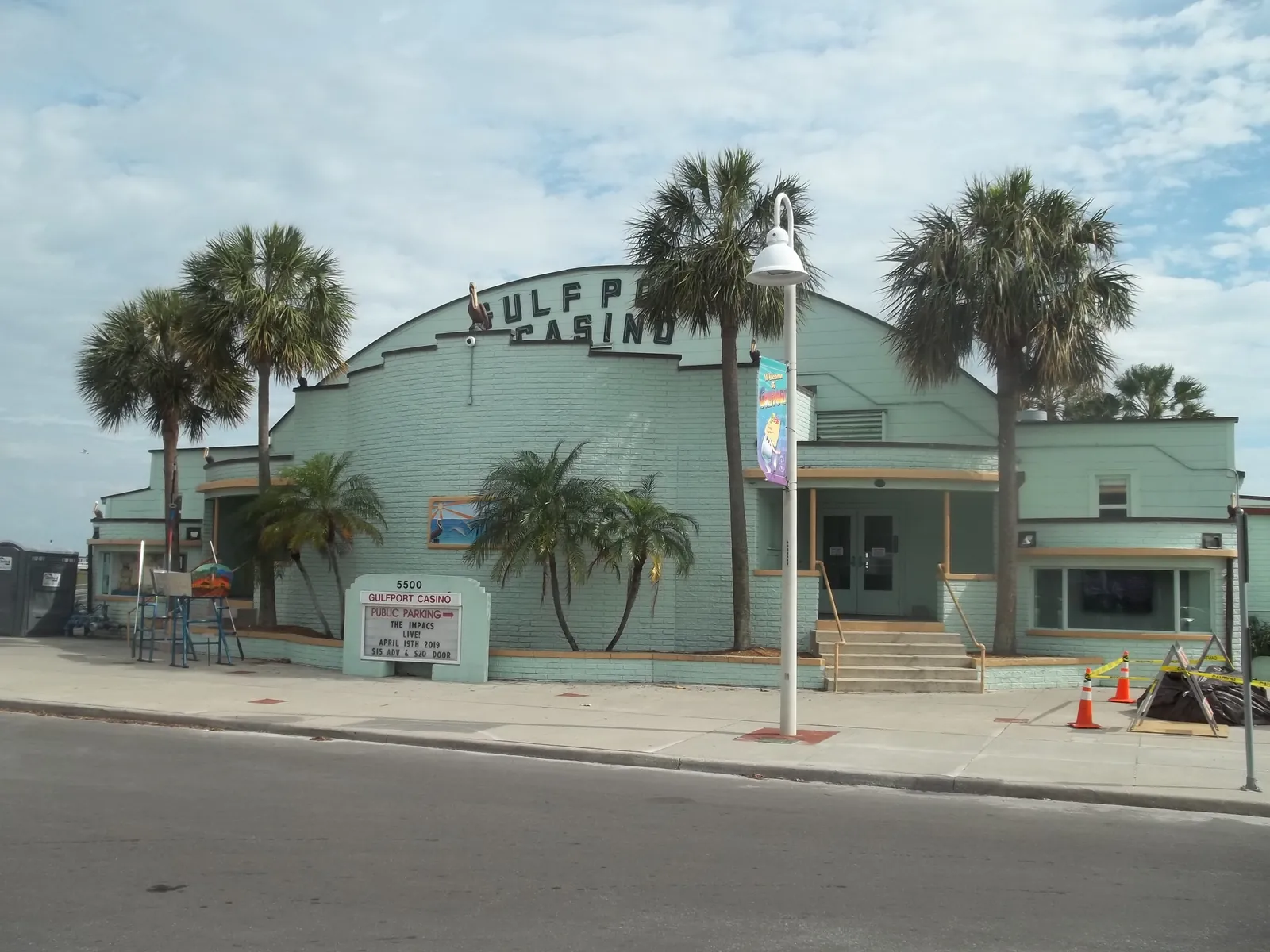
The Gulfport Casino today: a long, low mint-green building with a curved barrel-vault front reading GULFPORT CASINO, framed by tall palms under a bright sky.
The Gulfport Casino today — still right at the water
The Gulfport Casino. The 1934 dance hall still stands at the edge of Boca Ciega Bay, where the whole town’s idea of cooling off once lived. Present-day photograph. Photo: Ebyabe, CC BY-SA 4.0, via Wikimedia Commons.

Here’s a thing about Gulfport that stops making sense the moment you’ve got air conditioning: for about fifty years, the coolest place in the whole town wasn’t a room. It was a dance floor, built out over the open water of the bay — and you got to it by streetcar.

People rode the trolley down through the bottom of the peninsula, out onto a pier that ran hundreds of feet into Boca Ciega Bay, and spent the evening dancing in about the only place for miles where the air actually moved. That was the draw. Not the band. The breeze.

Which is a peculiar thing to hang a town’s whole night life on — until you remember there was no other cool to be had anywhere.

Cool was a place, not a thing you owned

Picture a Florida summer with the machine taken out of it. No air conditioning anywhere — not the house, not the church, not the corner store, not one single room a person slept in. The heat didn’t break at sundown. It sat down on the whole peninsula and waited for morning.

A 1909 photograph of a screened sleeping porch built on a rooftop, with a railing and a ramp, open to the open air on all sides.
Even the President slept on a screened porch. 1909
A screened sleeping porch, 1909 — this one built on the roof of the White House, before any machine existed to cool a bedroom. All across the hot half of the country, families slept out in the night air on porches like it. Photograph via the Library of Congress. Representative of the era; not Gulfport.

So cool wasn’t something you switched on. It was somewhere you went. The shady side of the street at noon. The porch after dark. And if you were lucky enough to live near the water, the edge of the bay, where the wind came in off the Gulf and did the one thing nothing indoors could do. It moved.

Gulfport had that wind. The whole lower tip of the peninsula pokes straight out into the water, and the evening breeze rolls right up Boca Ciega Bay. A town sitting in the path of it had something worth selling.

So they built the cool out on a pier

And somebody worked out how to sell it. In 1906, at the end of a long dock reaching some eight hundred feet into the bay, a two-story wooden building went up. Downstairs did the plain business of a waterfront — a ticket window, a post office, a soda fountain, the stop where little steamboats loaded up and ran people across to the beach at Pass-a-Grille.

Upstairs, they put a dance floor. Right out over the water, where the breeze had nothing to do but pour straight through it.

A 1919 photograph of a long open-sided streetcar packed with passengers on its bench seats, running on tracks down a tree-lined street.
The open cars ran you out to the breeze — 1919
An open-sided streetcar, 1919. Cars like this — walls that were really just a roof and a breeze — carried the crowds to the waterfront in the years before air conditioning. At Gulfport the tracks ran straight out onto the pier. Photograph, Asheville, North Carolina, 1919, public domain, via Wikimedia Commons. Representative of the era; not Gulfport.

The streetcar line ran its rails out onto the pier itself, so you could step off the trolley and be standing over the bay without once touching dry ground. You rode the rails out to the cool and danced until the last car home. They called it the Casino — not for gambling, just the old word for a place you went to be entertained.

This was the town’s air conditioning, and it worked the only way cool could work back then. You had to go out and stand in it.

The Gulfport Casino seen from the beach: the long building stands just behind a low seawall at the water's edge, with a person wading in the shallow bay in the foreground.
Built right at the water’s edge, on purpose
The Casino from the beach. Every version of it was set out at the water deliberately — close enough that the bay breeze could walk right in the windows. Present-day photograph. Photo: Ebyabe, CC BY-SA 4.0, via Wikimedia Commons.

The bay took it back

Then, in October of 1921, the thing that always eventually happens on a Florida coast happened. A hurricane — the big one that every later storm around here got measured against — came up the bay and tore the Casino to pieces. Wind and water pulled the dance floor off its pilings and scattered it down the shore as a pile of broken boards.

A black-and-white 1921 photograph of a two-masted steamboat run completely aground on dry land, its hull tilted and its rigging leaning, after a hurricane.
What the 1921 storm did to a bay boat
The steamboat Two-Forty, run aground by the hurricane of October 25, 1921, at Tampa. The same storm that leveled the Casino shoved bay boats like this one clear up onto dry land. Photograph, State Library and Archives of Florida, via Wikimedia Commons.

They built it back almost at once, because a town that sells the breeze can hardly be caught without a place to feel it. But the replacement went up fast and cheap, on skinny stilts out over the water, and it showed. The story people still pass around is of a bandleader eyeing the floor as the dancers got going and wondering, out loud, whether the whole shaky thing was about to drop them all into the bay.

It never did. But nobody was sorry when it came down.

The one that’s still standing

The Casino that replaced it is the one you’d find there today, and it’s the one worth knowing. In the thick of the Depression, the government work-relief money that was putting up courthouses and post offices all over the country built Gulfport a proper dance hall.

The front of the Gulfport Casino in daylight, its curved green facade and entrance flanked by palms, with benches and a small stage structure out front.
The 1934 Casino — the one that stuck
The Gulfport Casino, opened December 1934. Built on dredged-up ground behind a new seawall so the bay couldn’t carry it off again, designed by architect Frank Showerman, with a floor of solid maple that dancers would wear smooth over the next ninety years. Present-day photograph. Photo: Ebyabe, CC BY-SA 4.0, via Wikimedia Commons.

This time nobody trusted the bay. Crews dredged up the bottom and made solid ground to set the building on, then ran a seawall along the water’s edge so no storm could haul it off the way the first one went. It opened right at the end of 1934, built to stay this time, and it’s still there.

And underneath, it was still a machine for catching the breeze. The long walls were mostly windows — wide openings down both sides that threw the room open to the bay. On a summer night you danced with the Gulf air pouring straight through the building and across the floor. The Casino didn’t make the cool. It stood in the best spot in town to borrow it, and let the wind do the rest.

The waterside flank of the Gulfport Casino: a long covered deck with a wooden floor, a screened door, and a run of windows down the length of the building.
Walls that were mostly windows, and a deck on the bay
The Casino’s waterside. The open side deck and the long runs of windows are the whole idea in one picture — a building meant to let the bay breeze walk straight through it. Present-day photograph. Photo: Ebyabe, CC BY-SA 4.0, via Wikimedia Commons.
For half a century, Gulfport’s whole idea of beating the heat was a maple floor thrown open to the bay, and a west wind doing the work no machine yet could.

Then somebody closed the windows

Here’s the turn, and it’s a quiet one. In 1958, the city put air conditioning in the Casino.

A 1956 General Electric magazine advertisement for a slim room air conditioner, headlined that it takes up a third less space, showing the unit in a cheerful mid-century living room.
The thing that closed the windows — 1956
A 1956 room-air-conditioner advertisement. By the late 1950s a machine in the wall could beat the finest breeze off any bay — and the open windows that cooled a building for nothing suddenly had nothing left to do. General Electric, public domain, via Wikimedia Commons. Representative of the era; not Gulfport.

Think about what that actually meant. The whole reason the building existed — the open windows, the floor stuck out by the water, the breeze that was the entire point — was suddenly beside the point. You could shut the place up tight against a July night and make it cooler inside than the finest wind off the bay had ever managed. The cool stopped coming off the water. It started coming out of a machine bolted to the wall.

That same quiet swap was happening in every house in town around then, just less visibly. After the war the air conditioner had finally shrunk small enough and cheap enough to sit in a window instead of filling a basement. One by one, up and down the Gulfport streets, the windows closed, the porches went quiet, and the cool a family used to go outside and chase came indoors and hummed in the corner.

What the breeze left behind

So the thing that made Gulfport — the bay wind you once rode a streetcar out over the water to feel — isn’t really what keeps anybody cool here now. The breeze still comes up Boca Ciega Bay every evening, soft and off the Gulf, exactly the way it did when the first dance floor went up out over the water in 1906. It’s just that nobody’s counting on it anymore.

The side wall of the Gulfport Casino painted with a large red 'Welcome to Gulfport' mural, with palms and a bright sky above.
Still here — cooled now like everything else
“Welcome to Gulfport.” The Casino still stands at the water and still fills most nights with people dancing on that same maple floor — kept cool now, like every room in town, by the machine instead of the wind. Present-day photograph. Photo: Ebyabe, CC BY-SA 4.0, via Wikimedia Commons.

The streetcar’s long gone and the steamboats with it. But the building the whole town’s cool once ran through is still standing at the edge of the bay — the windows that used to stay thrown open now closed against the heat, the breeze outside blowing for nobody in particular. A town that once built its cool out over the water, and rode a trolley to go stand in it. These days the coolest room in Gulfport is just whichever one you happen to be in, with the windows shut.

A present-day note · I Know A Guy AC

Gulfport built its cool out over the water. We just stopped waiting on the wind.

That’s the thread running through the whole story — the streetcar out to the pier, the open windows on the maple floor, a whole town leaning out over the bay to catch a breeze. For fifty years, going out and standing in the wind was the best cooling anybody had.

Keeping a Tampa Bay home cool is still the entire job — we just don’t leave it up to the wind anymore. We do it with real equipment, sized and set up for your actual house, so a Gulfport August turns into something you only feel in the few steps between the car and the front door.

Right up until the afternoon it quits — and it always picks the hottest one. When that happens, you’ve got an easier move than any of those dancers waiting on the evening breeze ever did. You don’t have to go anywhere to find the cool. You make one call, because for keeping a home cool the modern way… we know a guy.

See what a new system costs→
Sources & Photo Credits

On the history

Photographs

  1. The Gulfport Casino (HERO, present day) — the 1934 Casino Ballroom on Shore Boulevard. Photo: Ebyabe, CC BY-SA 4.0, via Wikimedia Commons. File: gulfport-casino-today.
  2. A screened sleeping porch (1909) — sleeping porch built on the roof of the White House during the Taft administration, via the Library of Congress. Shown as a correctly-dated period example of how families slept in the night air before air conditioning; not Gulfport specifically. File: sleeping-porch-1909.
  3. An open-sided streetcar (1919) — open Brill streetcars, Asheville, North Carolina, 1919; public domain, via Wikimedia Commons. Representative of the open cars that carried crowds to waterfront resorts in the era; not Gulfport specifically. File: open-streetcar-1919.
  4. The Gulfport Casino from the beach (present day) — the Casino at the water’s edge behind the seawall. Photo: Ebyabe, CC BY-SA 4.0, via Wikimedia Commons. File: gulfport-casino-from-the-beach.
  5. Steamboat Two-Forty aground after the hurricane of October 25, 1921 (Tampa) — State Library and Archives of Florida (Florida Memory), via Wikimedia Commons. The 1921 Tampa Bay hurricane is the storm that destroyed the first Gulfport casino. File: steamboat-aground-1921.
  6. The Gulfport Casino, front (present day) — the 1934 building that still stands. Photo: Ebyabe, CC BY-SA 4.0, via Wikimedia Commons. File: gulfport-casino-bandstand-front.
  7. The Casino’s waterside deck and windows (present day) — the open side of the building. Photo: Ebyabe, CC BY-SA 4.0, via Wikimedia Commons. File: gulfport-casino-open-side.
  8. A 1956 room-air-conditioner advertisement — General Electric, public domain, via Wikimedia Commons. Shown to mark the arrival of home air conditioning in the 1950s; not Gulfport specifically. File: room-air-conditioner-1956.
  9. “Welcome to Gulfport” mural on the Casino (present day) — the painted side wall of the Casino. Photo: Ebyabe, CC BY-SA 4.0, via Wikimedia Commons. File: gulfport-casino-welcome-mural.

Present-day photographs are identified as modern; period images carry their known dates. Where an image is representative of the era rather than of Gulfport itself — the 1909 sleeping porch, the 1919 open streetcar, and the 1956 air-conditioner advertisement — this record says so rather than implying a false location. Gulfport’s own earliest photographs (the 1906 pier casino, the streetcar on the dock) sit largely in bot-walled archives; where that is the case this page uses correctly-identified present-day views of the surviving Casino and era-correct period images instead of mislabeling a stock photo as historic. The 1921 storm photograph is a genuine Tampa Bay image from the same hurricane that destroyed the first casino. Untouched original downloads are kept alongside this page in assets/images/originals/ with a full research record in source-record.md. No image’s factual content was altered; the print frames and handwritten notes are CSS added around the photographs, never onto them. Any owner who would like an image removed need only ask.